
Deal Anatomy: Ngutu College
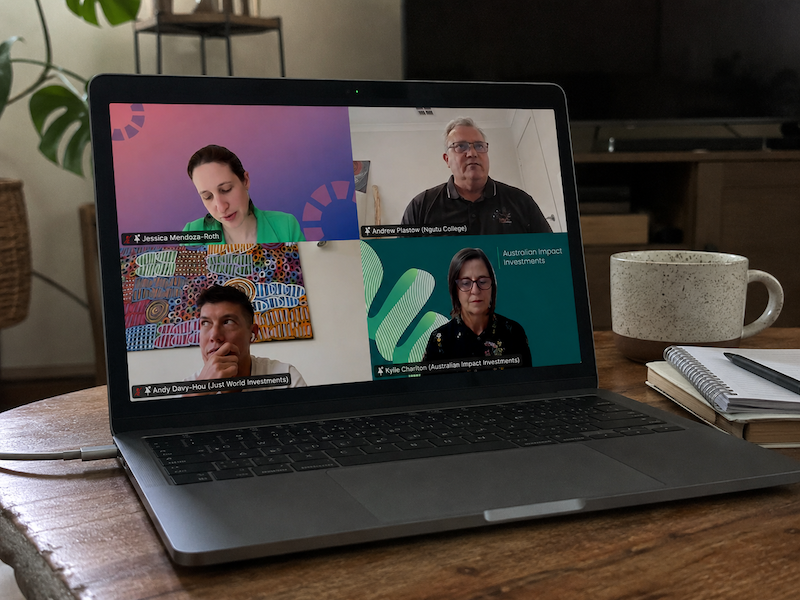
Based on Deal Anatomy: Inside an Impact Investment Transaction, an Impact Investing Hub webinar held on 8 May 2026. Panellists: Andrew Plastow (Ngutu College), Kylie Charlton (Australian Impact Investments), and Andy Davy-Hou (Just World Investments).
At 11am on the first day of the 2021 school year, Ngutu College became a legally registered school. By that point, 90 students had already arrived on site. They had been turning up on the strength of expressions of interest and conversations with founder Andrew Plastow, a Gamilaroi man and former public school principal who had spent 18 months mortgaging his home, drawing down his life savings, and volunteering to get the school off the ground.
A $1.3 million syndicated loan from eight lenders had been negotiated in parallel with the registration application, a building fit-out, and a recruitment exercise built almost entirely on personal relationships. Each piece depended on the others. Traditional bank lending was not an option for Ngutu College Ltd.
The deal sequence
Ngutu College is a preschool-to-Year-12 independent school in Adelaide, currently enrolling 315 students against a maximum capacity of 350, with First Nations students comprising half the school population. There have been multiple deals structured by Kylie Charlton at Australian Impact Investments:
2021, $1.3 million syndicated loan with 8 lenders. This provided operational funding for launch, sized to roughly twelve months of Commonwealth recurrent funding, to fund the gap before retrospective government payments arrive.
2023, $4.6 million syndicated loan with 15 lenders. This refinanced the $800,000 that was still outstanding from 2021 ($500,000 was already repaid) and funded $3.5 million of capex to renovate a vacant building on site, enabling extension through Year 12.
2024, $2.5 million subordinated debt amendment. Lender approval for three classrooms, six music spaces, a music studio, two offices, and amenities.
2026, refinance under discussion. Negotiations underway to roll the $4.6 million syndicated loan and a $2.5 million subordinated loan into a single facility with a repayment profile better matched to operating cashflows.
What the due diligence required
The diligence work behind the first loan was substantial, and Plastow credits it with strengthening the school. "If you want to know anything about me that I don't know myself, ask Australian Impact Investments," he says. "I say that with lightness, but it does demonstrate the rigour that Kylie and her team put into that process to make sure risks are mitigated."
Charlton's team wanted detail on the demographic case (how the school would scale from 90 children at launch to a 350 enrolment with half First Nations by 2028), the financial model (which Plastow built across more than 50 spreadsheets over 18 months), the building (a 1942 Finsbury ammunition factory the school would have to make habitable for children), and the team. Beyond Plastow himself, AII wanted to know who the finance manager was, whether the teaching staff was in place, and how the cultural governance would work in practice. As Plastow puts it: "While it feels like a lot of work at the time, it means the chances of success are far greater. The rigour actually supports the success of the organisation."
The trade-off, stated honestly
Andy Davy-Hou of Just World Investments, one of the original eight lenders, gave a candid account of how concessional loan terms shrink the pool of available capital:
"The higher that level of impact is, the lower I am willing to go away from market returns. If you really want deep impact, it is very hard to get market returns, because not only are there not that many deals out there, but the people chasing market returns aren't interested in reporting it properly."
That cuts against any framing suggesting deep-impact deals routinely clear commercial return hurdles. They sometimes can. Often they can't, and the investor pool willing to accept the trade-off is small. Ngutu sits in that smaller pool.
The compounding of trust
Kylie Charlton reflected on the fact that it was much easier to raise the $4.6 million from 15 lenders in 2023, compared with the $1.3 million in 2021, because Ngutu College had track record and was on track repaying the initial loan.
Andy Davy-Hou described the same shift from the lender side: "Like with most startups and new businesses, there is a leap of faith involved. You go through the rigours of the due diligence, and I trusted Kylie and her team. Once those boxes are ticked, it still is a leap of faith, but it's a smaller leap." The leap is now smaller still. Just World has since contributed philanthropically toward a new school bus on top of its lending position. "The track record's there, the trust has been proven, the reporting is on time," Davy-Hou said. "It's just another example of how the trust and the track record can keep building things."
What Ngutu has produced
The 2021 model assumed 15% First Nations enrolment, scaling to 50% by 2028. The school hit 50% well ahead of schedule, with enrolment at 315 of a 350 cap. One of the original conditions of the 2021 loan was that the school would reach Year 12 by 2026. It has. Three deals have closed on time and $500,000 of the 2021 facility was repaid ahead of the 2023 refinance.
The fourth transaction is now in negotiation.