
Izzy Jensen, Managing Partner at Transition Accelerator, presented Wilyun Pools as a live case study at IIH's masterclass, Blending grants, debt and equity to fund growth, on 25 August 2026.
Specialist climate investor Wollemi Capital had said no.
Wilyun Pools had gone to Wollemi's Investment Committee as a straight commercial deal, and the returns did not clear the benchmark return hurdle. On paper it was 1,200 hectares in Western Australia's Great Southern region, sitting between two existing nature reserves. The returns did not stack up, and the deal was dead.
Transition Accelerator thought the project was worth another look. The land formed a wildlife corridor between the two reserves, and the carbon revenues could fund a pathway to First Nations land ownership outside the native title process. The impact was there; the returns were not. The question was what it would take to make the project fundable.
The answer was a $3 million interest-free loan into a $9 million project. With that concessional capital in place, Wollemi Capital re-assessed the risk-return profile and committed $6 million in commercial equity. A project that had died at the Investment Committee became fundable.
How the structure worked
Transition Accelerator did not hold the project up while it found the money. It underwrote the full $3 million itself, giving Wollemi Capital certainty before a single philanthropic dollar was secured, and then went to market to sell the position down. Six foundations ultimately participated: Bowness Family Foundation, Fouress Foundation, Spinifex Trust, Tim Bishop Foundation, Foundation for Rural and Regional Renewal, and UBS Optimus Foundation. The loan runs for 10 years at zero interest. The foundations receive no cash coupon; what they receive instead is a deemed distribution they can count towards their grants.
Because the loan was made at below-market rates to a qualifying Deductible Gift Recipient (DGR1) entity, the Australian Taxation Office allows the gap between the market interest rate and the actual rate to count towards a foundation's annual minimum distribution requirement. The market rate was established through letters from two commercial banks; the gap between that rate and zero is what each foundation counts.
Transition Accelerator also negotiated a share of the upside: if Wollemi Capital outperforms its return hurdle, 25% of that outperformance flows back to Transition Accelerator to be recycled into similar mission-aligned projects.
Security was taken over both the land and the carbon rights, which were deliberately separated in the structure. The land is intended to transfer to the Wirlomin Noongar community over the life of the project; the carbon rights give lenders a backstop if something goes wrong before that transfer completes.
Raising the capital
Eighteen months passed between the underwrite and financial close.
Jensen is clear about where the time went. Everyone they approached liked the concept. What slowed things down was the deemed distribution mechanism, which has very few precedents in the Australian market, and the investment managers sitting between the foundations' grantmakers and their corpus.
Every foundation that ultimately lent to the project was internally managed by a family office. None came through an external wealth advisor. The smallest contribution was $125,000.
The reason is structural: wealth advisors have no financial incentive to recommend an instrument like this, and the due diligence takes work. The only foundations that got there were those where the grantmaker and the investment decision-maker sat in the same room.
Transition Accelerator convened those meetings. Getting the investment manager and the grantmaker in the room together, rather than working each separately, was what moved the deal.
What it looks like on the ground
The project is in its establishment phase, and the early markers are physical. So far 115 hectares have been seeded with local species for biodiversity restoration. Between 2024 and 2025, 300 hectares of Tasmanian blue gums were planted for carbon storage, with 260 hectares more in the pipeline. Over the life of the project those plantings are projected to abate approximately 430,000 tonnes of carbon. Malleefowl, listed as endangered and culturally significant to the Wirlomin Noongar, have returned to the property and are building nests.
Over the life of the project, the land will be returned to the Wirlomin Noongar people. That is what makes the structure distinct from most conservation finance deals: the outcome is not advisory participation or community engagement. It is ownership.
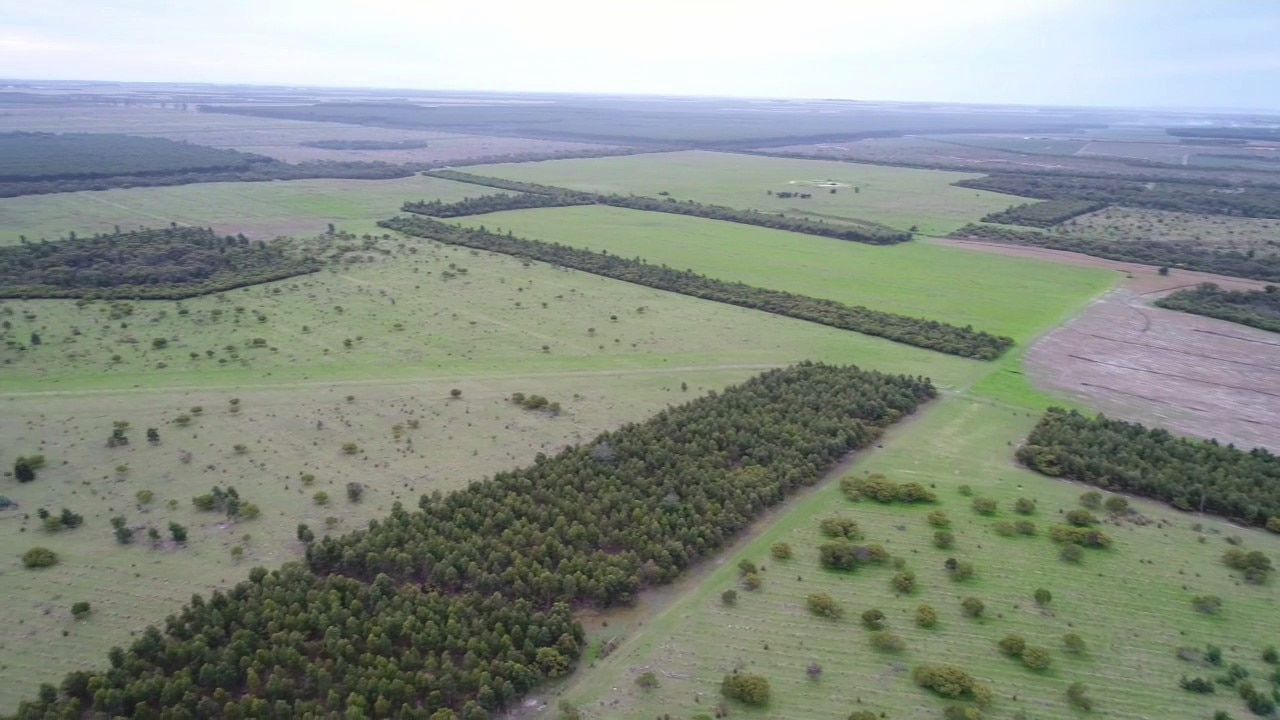
Revegetated wildlife corridors already in place on Wilyun Pools Farm. Image: Peter McKenzie.
What the deal shows
For every dollar of philanthropic capital lent into Wilyun Pools, two dollars of commercial capital followed. Funding the whole $9 million would have been a big ask for philanthropy; instead $3 million of debt crowded in $6 million of equity from Wollemi Capital, the foundations get their principal back at the end of 10 years, and that capital can go into the next project.
As Jensen puts it: "Instead of granting your capital, if you lend it, you can get it back, and then you can go and put it into the next project."
Transition Accelerator played three roles here: structurer, underwriter, and syndicate agent for the lender group. Not every deal needs all three. But a structuring intermediary, and someone to hold the position while foundations work through their internal processes, was not optional in this case. The deal would not have closed without it.
That is the wider value of Wilyun Pools: it builds track record and sets a precedent. The deemed distribution mechanism is hard to use in Australia partly because so few have used it. Every deal that closes makes the next one easier to explain.
Short-form videos from this session are available on the IIH Video Hub.